

Table of Contents
- Why Starting Fitness Over 50 Changes Your Health Trajectory
- Step 1: Get Medical Clearance and Set Your Baseline
- Step 2: Strength Training for Seniors: Why Muscle Matters Most
- Step 3: Build Your Beginner Workout Plan for 50 Year Olds
- Step 4: How to Prevent Injury When Exercising Over 50
- Step 5: Nutrition for Active Adults Over 50
- Overcoming Mental Barriers and Staying Consistent
- Your Next Step: Start With Expert Guidance
- Frequently Asked Questions
Last Updated: September 8, 2026
Why Starting Fitness Over 50 Changes Your Health Trajectory
The decision to start exercising after 50 is not about reclaiming a past physique; it is about fundamentally altering how your body ages. Fitness over 50 is the single most effective tool for maintaining independence, managing chronic conditions, and preserving muscle mass.
Most people assume the biggest barrier is physical capability. In practice, the psychological hurdle of “starting late” is often harder to clear than the workout itself. This guide from TRV|FIT Berkley breaks down how to start fitness over 50 safely, using a five-step framework prioritizing medical clearance, strength, and consistency.
This guide breaks down how to start fitness over 50 safely, using a five-step framework prioritizing medical clearance, strength, and consistency: getting cleared by your physician, building baseline strength, structuring a weekly plan, preventing injury, and supporting your training with proper nutrition.
Step 1: Get Medical Clearance and Set Your Baseline
Before your first workout, a conversation with your physician is non-negotiable. Many adults over 50 manage conditions like hypertension, arthritis, or type 2 diabetes, and exercise prescription must account for these variables.
Your doctor will assess your resting heart rate, blood pressure, and current medication profile to identify any limitations. Once cleared, establish a baseline: how many minutes of brisk walking can you sustain? How many bodyweight squats can you complete with good form? These numbers, not your age, are your starting point.
What to Ask Your Doctor Before You Begin
Bring a specific list of questions to your appointment. Ask whether any of your medications affect your heart rate response to exercise. Ask if there are movements you should avoid given your joint health or past injuries. And ask whether moderate intensity, defined as being able to talk but not sing during activity, is an appropriate target for your first month. According to the American College of Sports Medicine guidelines for exercise testing, medical clearance is particularly important before beginning moderate to vigorous activity for those with known cardiovascular, pulmonary, or metabolic disease.
Skipping medical clearance is the most common mistake beginners make. Ignoring an underlying condition like undiagnosed hypertension can turn a well-intentioned workout into a cardiac event. Always get physician approval before starting a new exercise program.
Step 2: Strength Training for Seniors: Why Muscle Matters Most
Strength training for seniors is not about building a physique; it is about combating sarcopenia, the age-related loss of muscle mass that accelerates after 50. This loss directly impacts metabolic rate, bone density, and your ability to perform daily tasks like carrying groceries or rising from a chair.
Resistance training is the most effective countermeasure. Lifting weights, using resistance bands, or performing bodyweight exercises signals your body to preserve and build muscle tissue. Progressive overload is critical: gradually increase the weight or repetitions to force adaptation. Aim for two to three sessions per week, targeting all major muscle groups.
Strength training also protects your joints. Stronger muscles stabilize the knee, hip, and shoulder joints, reducing the load on cartilage and lowering the risk of osteoarthritis progression. For beginners, starting with machines or supervised free weights ensures you learn the movement pattern before adding load.
A Concrete Starting Protocol for the First 8 Weeks
To move from theory to practice, here is a structured protocol prioritizing safety and adaptation. A qualified coach would adjust this template based on your baseline assessment from Step 1.
Frequency: Two full-body sessions per week, with at least 48 hours between them (e.g., Monday and Thursday).
Exercise Selection: Focus on compound, multi-joint movements that build functional strength. A foundational list includes:
- Lower Body: Bodyweight squats (or sit-to-stand from a sturdy chair), step-ups onto a low platform (4-6 inches), and glute bridges.
- Upper Body (Push): Wall push-ups, progressing to incline push-ups on a countertop.
- Upper Body (Pull): Seated resistance band rows, anchored at chest height.
- Core: Dead bugs and bird-dogs, performed slowly with controlled breathing.
Sets and Repetitions: For the first two weeks, perform 2 sets of 10-12 repetitions for each exercise. The goal is to learn the movement pattern with perfect form. The last repetition should feel challenging but not impossible.
Progression: After the initial two-week familiarization phase, the principle of progressive overload kicks in. Here is a simple, safe progression model:
- Weeks 3-4: Increase to 3 sets of each exercise, keeping the same rep range.
- Weeks 5-6: If you can complete all 3 sets of 12 reps with perfect form, it is time to increase the challenge. For bodyweight exercises, make the movement harder (e.g., lower the chair height for squats, or move from a wall push-up to a countertop push-up). For band exercises, move to a band with more resistance.
- Weeks 7-8: Continue the pattern. Aim to add one or two repetitions to your final set each week, or hold the top position of a movement (like a squat) for a 3-second isometric hold.
A common pattern for beginners is to feel great in weeks 1-2 and overdo it in week 3. Stick to the plan. The goal is to be slightly challenged, not exhausted. The ‘grind’ mentality that worked in your 30s is a primary cause of injury in your 50s. Your new metric for a good workout is leaving the gym feeling energized, not depleted.
Step 3: Build Your Beginner Workout Plan for 50 Year Olds
A beginner workout plan for 50 year olds must balance strength, cardiovascular endurance, and mobility. The goal is consistency, not intensity. A sustainable plan for the first four to six weeks looks like three days of training per week, with at least one rest day between sessions.
Each session should begin with a five-minute warm-up of light cardio and dynamic stretching. The main workout should combine resistance exercises with short bouts of aerobic activity.
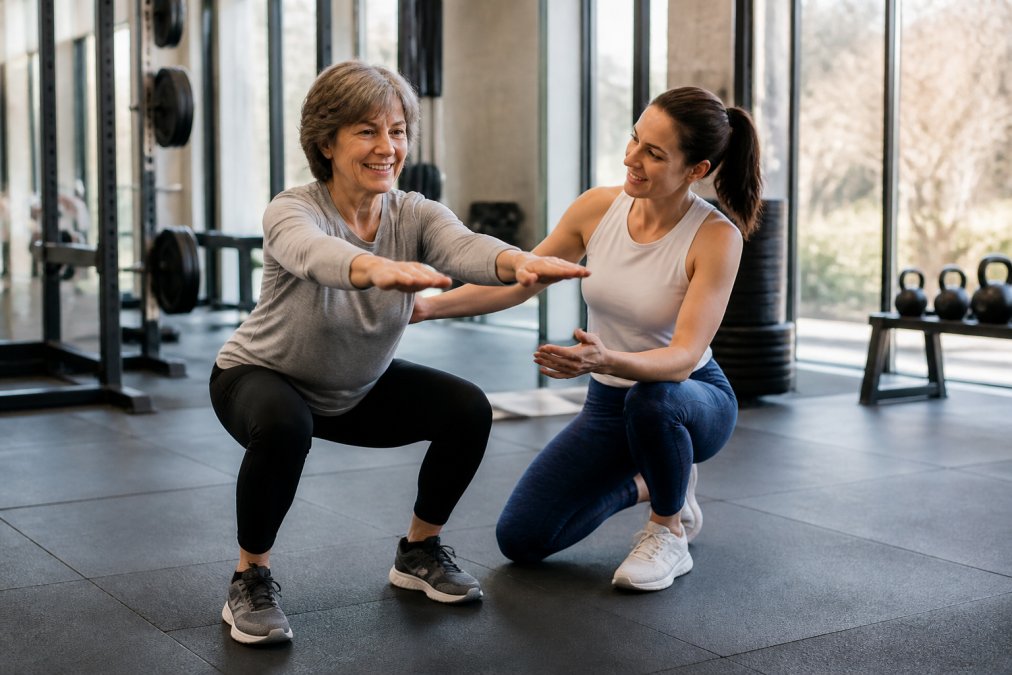
A Sample Week: Low-Impact Aerobics, Resistance, and Recovery
Here is a realistic weekly structure that prioritizes recovery and low-impact movement:
| Day | Focus | Example Session | Duration |
|---|---|---|---|
| Monday | Full-Body Strength | Bodyweight squats, wall push-ups, seated rows | 30 minutes |
| Wednesday | Low-Impact Aerobics | Brisk walking or stationary cycling, moderate intensity | 25 minutes |
| Friday | Strength + Balance | Lunges, resistance band pulls, single-leg stands | 30 minutes |
| Weekend | Active Recovery | Gentle yoga or a long walk | 20-30 minutes |
This schedule includes two dedicated strength sessions and one aerobic session. Balance training is woven into the Friday workout because it is the most direct way to prevent falls. Rest days are not optional; they are when muscle repair and adaptation occur.
Step 4: How to Prevent Injury When Exercising Over 50
How to prevent injury when exercising over 50 comes down to respecting the recovery process and listening to your body. The most common injuries come from doing too much, too soon, with poor form.
The first rule is to prioritize movement quality over load. If you cannot perform an exercise with perfect control, you are not ready to add weight. The second rule is to never skip the warm-up or cool-down.
Fill out the form below to get started →
A third, often overlooked factor is managing your chronic conditions. If you have arthritis, you may need to modify the range of motion in certain lifts. If you have high blood pressure, avoid holding your breath during exertion (the Valsalva maneuver), which can spike blood pressure dangerously. A physical therapist or qualified coach can help you navigate these modifications.
Do not ignore sharp joint pain. Muscle soreness that peaks 24 to 48 hours after a workout is normal. Sharp pain during an exercise is a signal to stop. Pushing through it can turn a minor strain into a chronic issue that sidelines you for months.
Step 5: Nutrition for Active Adults Over 50
Nutrition for active adults over 50 is about supporting muscle repair and managing inflammation, not crash dieting. As your activity level increases, your protein requirements rise. Distribute protein intake across each meal to maximize muscle protein synthesis.
Hydration is equally critical. The sense of thirst diminishes with age, making older adults more prone to dehydration, which impairs performance and recovery. Drink water consistently throughout the day, not just during workouts.
Finally, focus on whole foods that support bone density and joint health. Adequate calcium and vitamin D intake are essential, and omega-3 fatty acids from fish can help manage joint inflammation.
The Protein Target Most People Miss
The single most impactful nutritional change for an adult over 50 starting a strength program is increasing daily protein intake. The current RDA of 0.8 grams per kilogram of body weight is widely considered insufficient for older adults engaged in resistance training (peer-reviewed research).
A practical, evidence-informed target for active adults over 50 is 1.2 to 1.6 grams of protein per kilogram of body weight per day. For a 180-pound (82 kg) person, this translates to roughly 100 to 130 grams of protein daily to support muscle repair and offset anabolic resistance.
To hit this target, distribute protein across three meals and one snack, which is more effective for muscle protein synthesis than eating it all in one sitting:
- Breakfast: 3 scrambled eggs (18g protein) with a side of Greek yogurt (15g protein).
- Lunch: A salad with 4 ounces of grilled chicken breast (35g protein).
- Snack: A protein shake with whey or plant-based protein powder (25g protein).
- Dinner: 5 ounces of baked salmon (30g protein) with quinoa and roasted vegetables.
This sample day provides approximately 123 grams of protein, hitting the target for a 180-pound individual.
A Unique Metric: Tracking Progress Beyond the Scale
When you start a fitness program, the scale becomes a source of anxiety. For adults over 50, body composition changes are slow, and daily weight fluctuations can be misleading. Instead of fixating on pounds, track functional metrics that reflect your true progress.
Here are three specific, measurable indicators to monitor monthly:
- Grip Strength: This is a well-established proxy for overall muscle strength and is linked to longevity. Measure it with a hand dynamometer or time how long you can hang from a pull-up bar. An improvement of even 5-10 seconds indicates a meaningful gain in functional strength.
- Gait Speed: Your walking speed over a short distance (e.g., 10 meters) is a powerful predictor of mobility and independence. Time yourself walking at your normal pace; as your fitness improves, your time should decrease. A common clinical benchmark is a gait speed of at least 1.0 meter per second.
- The 30-Second Chair Stand Test: From a seated position in a standard-height chair, stand up and sit back down as many times as you can in 30 seconds. For men aged 50-59, a score above 17 is above average; for women, it is above 15. Tracking this monthly provides an objective measure of lower-body strength.
Your nutrition plan is not about deprivation; it is about providing the raw materials for the muscle you are building. And your progress is not defined by your weight, but by your ability to move through the world with strength and ease. Track these functional metrics, and you will see progress that the scale cannot show you.
Overcoming Mental Barriers and Staying Consistent
The hardest part of fitness over 50 is not the physical work; it is showing up when motivation is low. Many adults feel they do not belong in a gym or worry about being the oldest person in the room.
The most effective strategy is to remove the decision-making process. Schedule your workouts at the same time and days each week, treating them as non-negotiable appointments. Write down how many repetitions you complete, how long you can walk, or how easily you rise from a chair. These functional gains appear long before the scale moves and provide the evidence you need to stay consistent.
Relying on a community also helps. An inclusive environment where coaches know your name and your goals shifts the focus from performance to progress. As outlined in the CDC’s physical activity guidelines for older adults, the key to long-term success is finding activities you enjoy and can sustain. That consistency, not intensity, is what delivers results.
Your Next Step: Start With Expert Guidance
Starting a fitness program after 50 requires more than a list of exercises; it requires a plan tailored to your body, your medical history, and your goals. The safest path is to begin under the supervision of experienced coaches who can teach you proper form and adjust the plan as you progress.
At TRV|FIT Berkley, we offer semi-private training for adults over 50. Our elite coaches, with over 14 years of experience, design programs that build strength, improve cardiovascular endurance, and support sustainable fat loss in a welcoming, inclusive space. We empower individuals to achieve their health and performance goals within a supportive fitness family.
Fill out the form below to get started and schedule your first session. Your future self will thank you for taking this step today.
Frequently Asked Questions
How many days a week should a 50-year-old lift weights?
For most beginners over 50, two to three days per week of strength training is enough to build muscle and improve bone density. You need at least one rest day between sessions for recovery. These sessions should target all major muscle groups using bodyweight exercises, resistance bands, or light weights. As you adapt, you can increase frequency or intensity. The key is consistency and progressive overload, not how much you do in a single session.
What are the 5 essential exercises for people over 50?
A solid routine includes: 1) Squats for leg strength and mobility, 2) Push-ups (on knees or against a wall) for upper body power, 3) Rows for posture and back health, 4) Planks for core stability, and 5) Balance exercises like standing on one leg to prevent falls. These compound movements improve functional fitness and support daily activities. Start with bodyweight versions and focus on perfect form before adding resistance.
Can you reshape your body at 50?
Yes. Muscle tissue responds to training at any age. While hormone changes can slow the process, consistent strength training combined with adequate protein intake can build muscle mass and reduce body fat after 50. Expect visible changes within 12 to 16 weeks of consistent effort. Progress may be slower than in your 30s, but it is real and sustainable. This is why focusing on strength, not just cardio, is critical for fitness over 50.
What safety precautions should I take before starting a new exercise routine?
First, get medical clearance from your doctor, especially if you have chronic conditions. Start every session with a 5 to 10 minute warm-up and end with a cool-down. Prioritize proper form over heavier weights to prevent injury. Stay hydrated and listen to your body: sharp pain means stop. Progress gradually with the principle of progressive overload, and consider working with a coach who can design a program specific to your needs.