

Table of Contents
- Why Standard Gym Memberships Fall Short on Coaching
- Comparing Top Personalized Coaching Alternatives
- Is Personal Training Worth the Cost?
- How to Choose a Personal Trainer for Your Goals
- Remote vs. In-Person: Which Coaching Model Fits Your Life?
- Make the Switch to a Coaching-First Fitness Model
- Frequently Asked Questions
Last Updated: September 7, 2026
Standard gym memberships sell access to equipment, not outcomes. For $40 to $60 a month, you get machines and free weights, but rarely someone who learns your name, watches your form, adjusts your program, and holds you accountable.
Personalized coaching is the difference between working out and training. Working out is showing up; training is following a structured plan designed for your body, goals, and schedule, with a coach who corrects technique and progresses loads based on real data.
At TRV|FIT Berkley, we have spent over 14 years building a coaching-first model that delivers exactly this. This guide compares the leading alternatives to standard memberships for anyone seeking genuine personalized coaching.
Why Standard Gym Memberships Fall Short on Coaching
The core problem is structural. Big-box gyms operate on volume, depending on many members who rarely attend. Coaching requires the opposite: fewer clients, deeper attention, and ongoing communication.
Most memberships include no coaching at all. A free “fitness assessment” at signup is typically a sales pitch for expensive add-on sessions, not an ongoing relationship.
The research on exercise adherence is clear. According to the American College of Sports Medicine’s guidelines on exercise and behavior change, consistent feedback and social support are among the strongest predictors of whether someone sticks with a program. A gym membership provides neither.
What members need is accountability, customized plans, and a coach who adjusts frequency and intensity as they improve. That is personalized coaching, and it is rarely available on a standard membership floor.
The hidden cost of big-box gyms is not the monthly fee. It is the months of stalled progress that come from following generic programs with no expert oversight. Many members train for a year with minimal strength gains because they never progress their loads or address movement faults.
Comparing Top Personalized Coaching Alternatives
The market has responded with several models, each with trade-offs in cost, convenience, and instruction quality. Filter by your experience level, budget, and the feedback loop you respond to.
The Decision Filter: Experience Level First
Most comparison guides treat beginners and advanced lifters the same, but the best model depends on whether you need to learn movement patterns from scratch or break through a plateau.
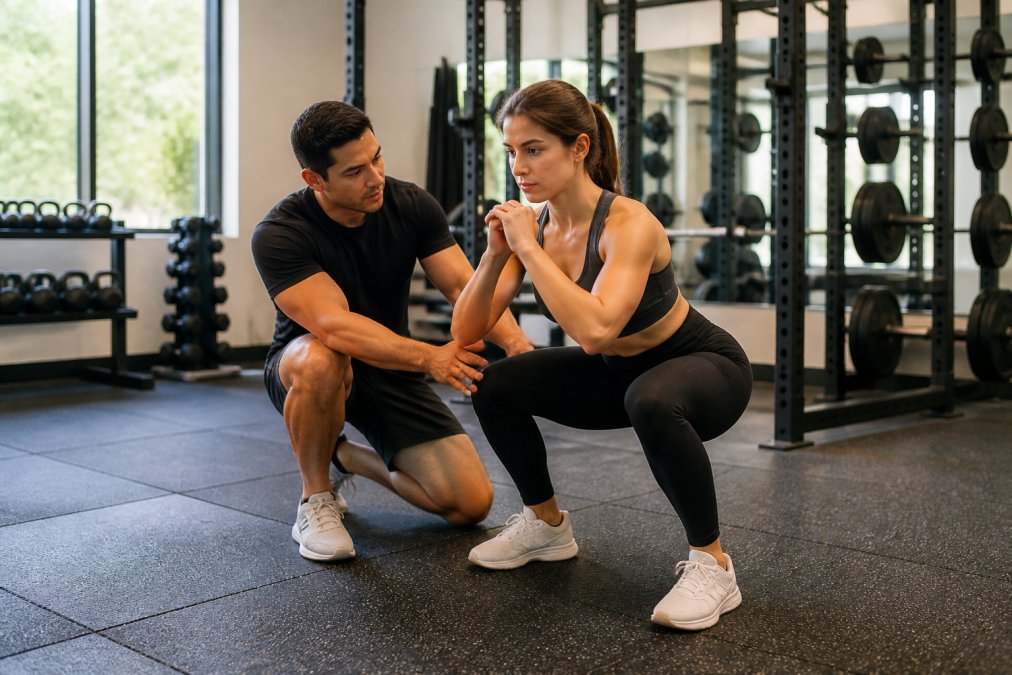
Beginners (under 1 year of consistent training): Your primary need is real-time form correction. A squat with valgus knee collapse or a rounded lumbar spine is a motor pattern problem no video review can fully fix. In-person semi-private or one-on-one sessions are the safest investment; the alternative is ingraining faulty patterns that take years to undo.
Intermediate lifters (1-3 years): You know basic patterns but struggle with programming progression. Remote coaching with video form checks can work if you honestly film your working sets, not just warm-ups. Platforms like Trainwell or Caliber can be effective if you commit to the video loop.
Advanced lifters and competitive athletes: You need a coach who understands periodization, sport-specific demands, and peaking protocols. Generic app-based programming will not cut it; look for demonstrable experience in your sport, whether powerlifting, HYROX, or boxing.
The Cost-Per-Touch Analysis
The real differentiator is not the monthly price tag, it is the number of meaningful coaching touches per dollar spent. A “touch” is any interaction where a coach gives specific, actionable feedback.
| Option | Monthly Cost Range | Coaching Touches Per Week | Cost Per Touch (Est.) | Best For | Key Limitation |
|---|---|---|---|---|---|
| TRV|FIT Berkley (semi-private) | $150-$250 | 3-6 in-person sessions with real-time correction | $25-$40 | Beginners, over-50 adults, competitive athletes | Requires commuting to the gym |
| Trainwell | $99-$199 | 1-2 video reviews plus messaging | $50-$100 | Self-motivated home exercisers | No in-person correction; depends on your filming consistency |
| Future | $199-$299 | Daily messaging, weekly plan updates | $50-$75 | Wearable users who want daily accountability | Premium cost; no hands-on correction |
| Everfit | $19-$99 (trainer-dependent) | Varies widely by trainer | Highly variable | Budget-conscious users | Coaching quality depends entirely on the individual trainer you select |
| Caliber | $150-$250 | Weekly check-ins, detailed analytics review | $40-$60 | Data-driven strength lifters | Can overwhelm beginners with metrics |
Pricing ranges reflect published U.S. subscription rates as of 2026. Actual costs vary by trainer and plan tier.
What the Table Does Not Tell You
The hidden cost of remote coaching is your own compliance. A 2023 survey found the median app-based fitness user stops logging workouts within 90 days (peer-reviewed research). In-person sessions force attendance via sunk cost; a remote app simply sends a notification you can ignore.
The hidden cost of in-person coaching is scheduling rigidity. If your work hours are unpredictable, a 6 PM slot may not work. Ask about cancellation policies and make-up sessions before committing.
Skill-Level Specific Recommendations
For beginners: Choose in-person semi-private training. The group setting provides peer motivation while the coach maintains a low client-to-coach ratio (ideally 4:1 or lower). You need eyes on your movement pattern for at least the first 8-12 weeks.
For intermediate lifters: A hybrid approach works best. Book one in-person session per month for a form audit, and use a remote platform for weekly programming and accountability.
For advanced lifters: Interview coaches about experience with your sport and how they periodize for competition peaks. A coach who has taken athletes to a HYROX podium understands the running-to-functional-work transition in a way a generalist does not.
Beware of any coaching platform that promises results without asking about your injury history, training background, or schedule. A quality coach conducts a thorough assessment before writing a single workout. If the signup process takes less than five minutes, the programming is likely templated, not personalized.
The cheapest coaching option is rarely the most cost-effective. Calculate the cost per coaching touch, not the monthly subscription fee, and match the model to your experience level. Beginners need eyes-on form correction; intermediates need structured progression; advanced lifters need sport-specific periodization.
Is Personal Training Worth the Cost?
The honest answer depends on what you compare it to, but you can decide with math instead of guesswork. The framework below compares the true cost of three common paths over 12 months.
The 12-Month Cost Comparison
Path 1: Standard Gym Membership Only
- Monthly fee: $40-$60 (average $50)
- Annual cost: $600
- Coaching touches: 0-1 (the initial “free assessment” that is really a sales pitch)
- Expected outcome: Minimal progress without external accountability. Industry data consistently shows that gym attendance drops by 50% or more after the first 90 days of membership.
- True cost per productive workout: Impossible to calculate because most members stop attending entirely.
Path 2: Standard Gym Membership + Remote Coaching App
- Gym membership: $600/year
- Remote coaching (Trainwell, Caliber, or similar): $1,200-$2,400/year
- Total annual cost: $1,800-$3,000
- Coaching touches: 1-2 video reviews per week plus messaging
- Expected outcome: Moderate progress if you remain disciplined about filming your sets and following the programming. The risk is that without scheduled in-person sessions, compliance drops after 8-12 weeks.
Path 3: Semi-Private In-Person Training (Coaching-First Model)
- Monthly fee: Available on website
- Annual cost: $1,800-$3,000
- Coaching touches: 3-6 in-person sessions per week with real-time form correction
- Expected outcome: Faster skill acquisition, safer progression, and higher adherence due to scheduled appointments and social accountability.
The ROI Calculation Most People Miss
Path 2 and Path 3 cost roughly the same annually. The difference is not price, it is the quality of the coaching touch.
A remote coach reviews a video you choose to film, so you self-select your best sets. The coach never sees the fifth rep where your lower back rounds or the set you cut short. The feedback loop is built on incomplete data.
An in-person coach sees every rep, notices the subtle shift in your stance when you fatigue, and adjusts your load on the spot. This real-time correction is the single largest predictor of safety and progress.
The Cost of Spinning Your Wheels
What most people underestimate is the cost of stalled progress:
Fill out the form below to get started →
- You pay $50/month for a gym membership for 12 months ($600 total)
- You follow a generic program from an app or a magazine
- After 12 months, your squat has not increased, your body composition has not changed, and you are considering quitting
- The $600 was not wasted on the gym, it was wasted on the absence of expert guidance
Now consider the alternative:
- You pay for semi-private coaching for 6 months
- You learn proper squat mechanics, deadlift setup, and pressing technique
- Your strength increases measurably each month, and you develop the confidence to train independently
- After 6 months, you have the skills to continue on your own, or you choose to stay for the community and accountability
The second scenario costs more upfront but produces a durable skill set. The first scenario produces nothing but frustration.
The Hybrid ROI Advantage
A hybrid model is emerging as the strongest option for many: train in-person for the sessions that matter most, learning proper movement patterns, and use remote check-ins for accountability between visits.
Here is the cost breakdown:
- 2 in-person semi-private sessions per week: See website for details
- 1 remote coaching app for programming between sessions: $50-$100/month
- Total: $200-$300/month
This gives you real-time form correction for the highest-injury-risk movements (squats, deadlifts, overhead presses) while using the app for accessory and cardio work. The cost is comparable to full remote coaching, but instruction quality is significantly higher.
When Coaching Is Not Worth It
Coaching is not worth it if you are not ready to commit. A coach cannot make you show up; if you are skipping workouts entirely, no model will fix that until you address the underlying habit.
Coaching is also not worth it if you choose the cheapest option and quit because results come slowly. Poor form performed consistently is still poor form and will eventually lead to injury.
The real question is not whether coaching is worth it, but which coaching model delivers results for your specific situation. Remote coaching at $99 to $199 per month might feel cheaper than in-person semi-private training, but it cannot correct your squat depth or notice the knee cave that will eventually cause pain. Calculate the cost per coaching touch, not the monthly fee.
Over a 12-month period, a standard gym membership costs $600 with near-zero coaching value. Semi-private training costs $1,800-$3,000 but delivers 150-300 coaching touches with real-time correction. The ROI difference is not subtle, it is the difference between renting equipment and buying results.
How to Choose a Personal Trainer for Your Goals
Start with your outcome, not the price. For heavy barbell strength work, you need a coach with demonstrable experience in that skill. If you are over 50 and managing age-related conditions, you need someone who programs for safety and joint health.
Professional certification matters, look for credentials from recognized organizations, but more important is the trainer’s experience with clients like you.
Ask direct questions before committing: How do they handle progress tracking? What does communication look like between sessions? How do they adjust programming when you plateau or miss sessions?
Semi-private training places you in a small group with a coach, giving you community accountability with individual attention. For many, it represents the best balance of cost and coaching quality.
Remote vs. In-Person: Which Coaching Model Fits Your Life?
Remote platforms like Trainwell, Future, and Everfit offer undeniable convenience, train from your living room, at 5 AM, or in a travel hotel. Your plan syncs to your phone and your coach checks in via messaging.
The trade-off is the loss of hands-on instruction. A video can show your form, but it cannot prevent the injury that happens on the third rep before you think to film it. Real-time feedback is the core advantage of in-person training.
The psychological barriers to remote coaching are also real. Without a scheduled class or appointment, it is easy to skip. The social accountability of showing up where coaches and members know your name is a motivator a phone notification cannot replicate.
The Centers for Disease Control and Prevention’s physical activity guidelines emphasize that consistency is the critical factor in achieving health benefits from exercise. Choose the model you will actually sustain, not the one that looks best on paper.
Make the Switch to a Coaching-First Fitness Model
The standard gym membership model is not broken; it is incomplete. It provides tools but withholds the instruction needed to use them effectively.
A coaching-first model inverts this. You start with an assessment of your fitness level, goals, and limitations; your program is built around that assessment; your coach tracks progress and adjusts your plan as you improve.
For beginners, this means learning proper form from day one. For adults over 50, it means programming that respects joint health while building strength. For competitive athletes, it means sport-specific training that prepares you for competition.
At TRV|FIT Berkley, the coaching-first approach combines elite instruction with an inclusive community. Every member is seen, challenged, and supported, whether taking their first fitness class or training for a HYROX event.
The gap between having a gym membership and making real progress is coaching. Generic programs and unmonitored workouts produce generic results. If you have tried the big-box route and found yourself plateaued or unmotivated, the fix is not more equipment, it is better guidance.
Our team at TRV|FIT Berkley has spent over 14 years building a coaching model that delivers improved strength, cardiovascular endurance, and sustainable fat burn through personalized attention. Fill out the form below to get started and experience the difference that dedicated coaching makes.
Frequently Asked Questions
How much is a personal coach at Anytime Fitness?
Personal training at Anytime Fitness is typically billed as an add-on to a standard membership, with costs varying by location and trainer experience. Many gyms offer packages that bring the per-session rate down, but the total can add up quickly. When comparing that cost against alternatives, focus on what is included: customized workout plans, nutrition guidance, and direct coach access. A semi-private training model or an app-based coaching subscription may provide more frequent check-ins and a more structured program for a similar or lower monthly investment.
What is the difference between app-based coaching and in-person semi-private training?
App-based coaching like Trainwell or Future offers remote guidance, video call check-ins, and programming delivered through a mobile application, which suits busy schedules. In-person semi-private training, such as the model at TRV|FIT Berkley, places you in a small group with a coach physically present to correct your form in real time. The main trade-off is convenience versus hands-on feedback. If you need immediate adjustments and thrive on in-person energy, semi-private training often delivers faster results. If flexibility is your top priority, a remote coaching app may be the better fit.
Can I get a personal trainer at Anytime Fitness?
Yes, many Anytime Fitness locations offer personal training sessions with certified coaches. However, the level of personalization and the coach’s availability can vary significantly from one franchise to another. If you are looking for a more consistent, coaching-first experience, you might consider dedicated personal training studios or online coaching platforms. These alternatives often provide more structured progress tracking, specialized programming, and a clearer focus on your specific goals rather than a general gym floor experience.
What should I look for when evaluating a personal trainer’s credentials?
Look for a nationally recognized certification such as NASM, ACE, or ACSM, which indicates a baseline of professional knowledge. More important is experience with clients who share your goals and any specialized certifications relevant to your needs, such as nutrition, sports performance, or working with older adults. Ask how they structure programs, how they track progress, and how they handle plateaus. A good trainer will also discuss your medical history and fitness assessment before designing a plan, ensuring the program is safe and appropriate for your starting point.
Are there benefits to semi-private training over one-on-one sessions?
Semi-private training offers a balance between personalized attention and community support. You get a coach who can still correct your form and adjust your program, but you train alongside a few other people with similar goals. This format often provides built-in accountability and a more motivating atmosphere than solo sessions, and it typically costs less per session than fully private coaching. For many people, the group dynamic helps with consistency, which is a key driver of long-term results.


